novo blog
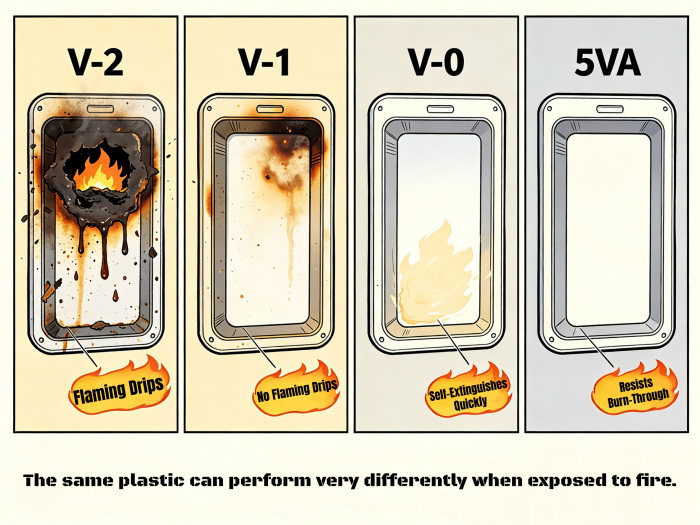
Você já notou marcações como "V-0" ou "V-1" em uma luminária? Provavelmente não — e isso é completamente normal.
Ao contrário do brilho ou da temperatura de cor, essas classificações não afetam o desempenho de uma luz no uso cotidiano. Mas em caso de incêndio, elas podem fazer uma diferença crítica para a segurança.
A maioria das carcaças de iluminação é feita de plástico. Quando inflamados, alguns plásticos queimam lentamente e se autoextinguem, enquanto outros continuam queimando intensamente e podem até pingar material em chamas, espalhando o fogo. A principal diferença está na sua classificação de retardante de chama.
Neste artigo, vamos explicar as diferenças entre UL 94 V-0, V-1, V-2 e 5VA e explicar o que cada classificação realmente significa.
UL 94 é um padrão de teste de inflamabilidade para materiais plásticos desenvolvido pela Underwriters Laboratories (UL). É o padrão mais utilizado no mundo para avaliar a resistência à chama de plásticos.
Embora tenha origem nos Estados Unidos, UL 94 tornou-se a referência reconhecida mundialmente para classificações de retardante de chama nos setores de iluminação, elétrico e eletrônico.
O padrão UL 94 inclui vários métodos de teste. Para materiais plásticos usados em carcaças de iluminação, as classificações mais comuns são:
Antes de comparar as classificações, é importante entender como o Teste de Queima Vertical UL 94 é realizado.
Um corpo de prova plástico padrão é montado verticalmente e exposto a uma chama em sua extremidade inferior por 10 segundos. Após a remoção da chama, os seguintes fatores são avaliados:
O procedimento de teste é idêntico para V-2, V-1 e V-0. A única diferença é o desempenho do material durante o teste, que determina sua classificação de retardante de chama.
| Classificação UL 94 | Tempo total de chama residual (Após duas aplicações de chama) |
Tempo máximo de chama residual (Cada aplicação de chama) |
Gotejamentos em chamas Inflama algodão? |
Desempenho típico |
|---|---|---|---|---|
| V-0 | ≤ 50 segundos | ≤ 10 s | Não | Maior nível de retardância à chama. Autoextinção rápida sem gotejamentos em chamas. |
| V-1 | ≤ 250 segundos | ≤ 30 s | Não | Boa resistência à chama. Autoextingue-se sem inflamar o algodão. |
| V-2 | ≤ 250 segundos | ≤ 30 s | Sim | Gotejamentos em chamas são permitidos e podem inflamar o algodão. |
| HB | — | — | — | Combustão horizontal. Taxa de queima ≤ 40 mm/min. Menor classificação UL 94. |
A principal diferença é a rapidez com que o material se autoextingue após a remoção da chama.
Conclusão:Materiais V-0 extinguem-se muito mais rapidamente, proporcionando um nível mais alto de segurança contra incêndio.
O procedimento de teste e os limites de tempo de chama residual são idênticos para ambas as classificações. A única diferença é o comportamento dos gotejamentos em chamas.
Gotas em combustão podem espalhar fogo para materiais próximos, tornando o V-2 menos adequado para aplicações que exigem um nível mais alto de segurança contra incêndio.
HB (Combustão Horizontal) é um método de teste completamente diferente. Em vez de montar o corpo de prova verticalmente, o material é testado horizontalmente e a taxa de queima é medida.
Para alcançar uma classificação HB, a taxa de queima não deve exceder 40 mm/min (dependendo da espessura do corpo de prova).
HB é a classificação UL 94 mais baixa e geralmente não é recomendada para aplicações de iluminação críticas para a segurança.
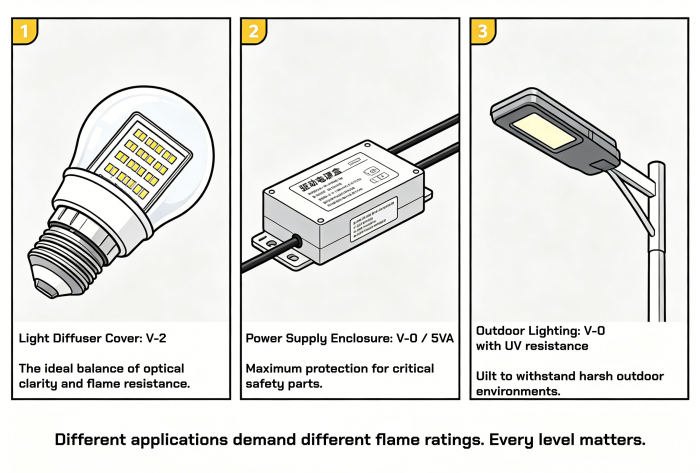
Para produtos de iluminação que exigem máxima segurança contra incêndio — como carcaças de drivers de LED, invólucros de fontes de alimentação e componentes críticos de iluminação externa — a classificação UL 94 5V é frequentemente especificada.
Comparada com as classificações da série V, o teste 5V é muito mais exigente. O corpo de prova é exposto a uma chama maior cinco vezes, com cada aplicação da chama durando cinco segundos. O teste também avalia se um corpo de prova de painel plano pode resistir à queima completa.
Como resultado, 5VA é amplamente considerado o maior nível de resistência à chama na norma UL 94. É comumente especificado para invólucros elétricos e componentes de iluminação críticos para a segurança, onde uma resistência superior ao fogo é essencial.
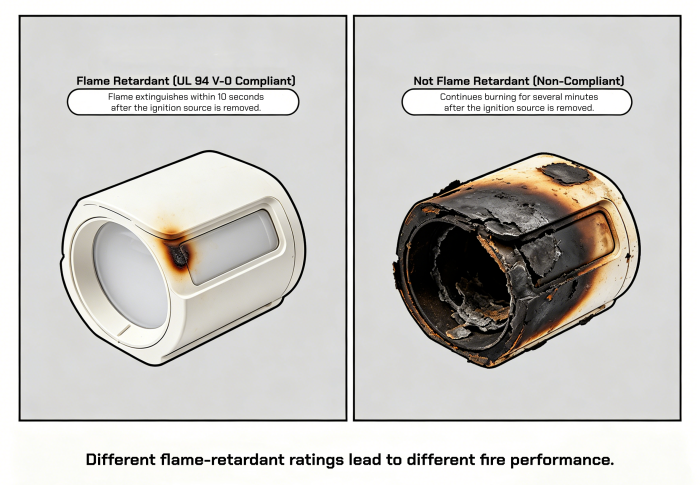
Um dos equívocos mais comuns é que uma classificação mais alta de retardância de chama significa que um material não pode queimar. Isso não é verdade.
Materiais retardantes de chama são projetados para retardar a propagação do fogo e se autoextinguir quando a fonte de ignição é removida — não para resistir ao fogo indefinidamente.
Mesmo um material UL 94 V-0 pode inflamar se for continuamente exposto à chama ou ao calor excessivo.
A resistência à chama ajuda a atrasar o crescimento do fogo, proporcionando tempo valioso para evacuação e resposta a emergências, em vez de tornar um material completamente à prova de fogo.
A resistência à chama por si só não é suficiente para aplicações de iluminação externa.
A exposição prolongada aos raios UV pode fazer com que os plásticos se tornem frágeis, descoloridos e mecanicamente mais fracos. Também pode reduzir o desempenho retardante de chama ao longo do tempo.
Escolha policarbonato (PC) estabilizado contra UV ou outros plásticos de engenharia resistentes a UV para garantir durabilidade e segurança a longo prazo.
Compreender essas diferenças ajuda engenheiros, designers e equipes de compras a selecionar o material adequado para cada aplicação.
Nossos engenheiros terão prazer em recomendar o material mais adequado com base nos requisitos do seu produto, método de processamento e certificações desejadas.
Entre em contato conosco hoje para discutir sua aplicação de iluminação ou solicitar uma consulta gratuita sobre materiais.
Siga-nos :


-- obtenha atualizações com os tópicos mais recentes

 o email
 português
 English
 français
 Deutsch
 русский
 italiano
 español
 العربية
 日本語
日本語 한국의
한국의 中文
中文