novo blog
In industrial and commercial applications, fans are essential components of cooling and ventilation systems. From factory ventilation and HVAC systems to industrial equipment cooling, fan blade performance directly affects operating efficiency, stability, and service life.
Material selection is one of the most important factors in fan blade design. Metal and plastic are two common choices, but as industrial equipment increasingly demands lightweight structures, energy efficiency, and reliable mechanical performance, traditional materials are facing new challenges.
Metal blades offer high strength, but their weight and potential corrosion issues may increase overall system costs. Conventional plastic blades are lightweight and corrosion-resistant, but may struggle with insufficient stiffness and deformation under heavy loads or prolonged operation.
So, which is the better choice for industrial cooling fans: metal or plastic?
In this article, we compare metal and plastic fan blades in terms of material properties, practical applications, and cost. We also explore how Long Glass Fiber Reinforced Thermoplastics (LFT) provide an additional material solution for industrial fan blade manufacturers.
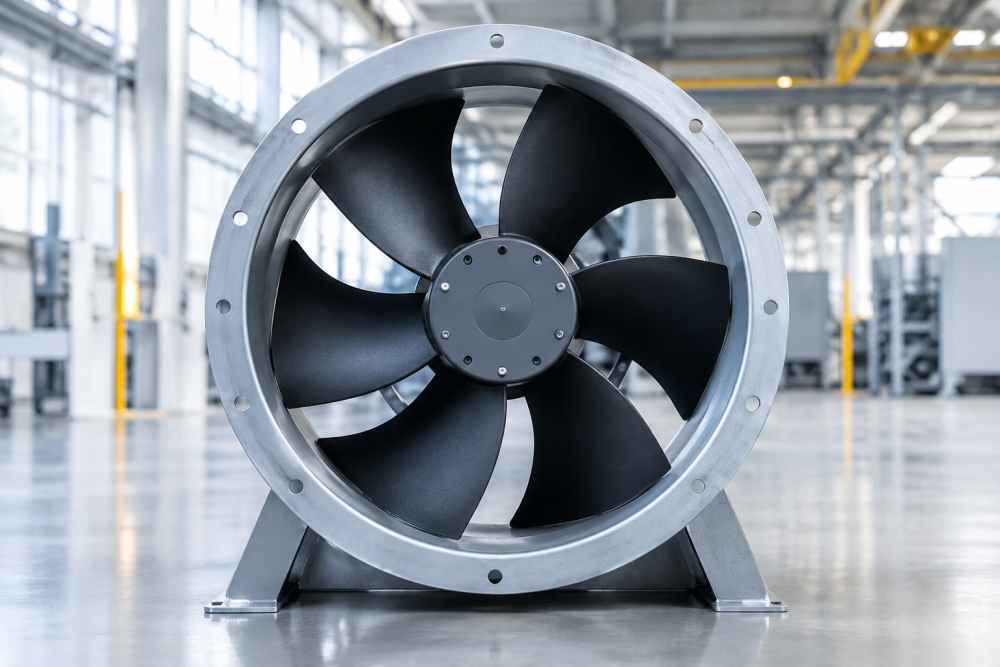
Fan blades are the key components in industrial fan systems responsible for generating airflow. Their geometry, blade angle, number, structural design, and material properties collectively determine airflow volume, air pressure, airflow distribution, and overall fan efficiency.
A high-performance industrial fan blade must do more than provide good aerodynamic performance. It must also meet several important mechanical requirements:
Therefore, fan blade materials should not be selected based on strength or weight alone. Rotational speed, blade dimensions, operating temperature, air pressure, and actual service conditions must all be considered.
Metal fan blades are commonly manufactured from aluminum alloys, steel, or stainless steel. They are widely used in industrial ventilation, heavy-duty equipment cooling, high-temperature environments, and other applications requiring substantial structural strength.
Plastic fan blades are commonly manufactured from thermoplastic materials such as ABS, polycarbonate (PC), and nylon (PA). They are widely used in commercial ventilation, air conditioning equipment, cooling systems, and general industrial fans.
As industrial fans continue to evolve toward higher efficiency, lighter structures, and greater operational reliability, traditional metal and conventional plastic materials may not meet every application requirement.
Long Glass Fiber Reinforced Thermoplastics (LFT) offer another option for fan blade design.
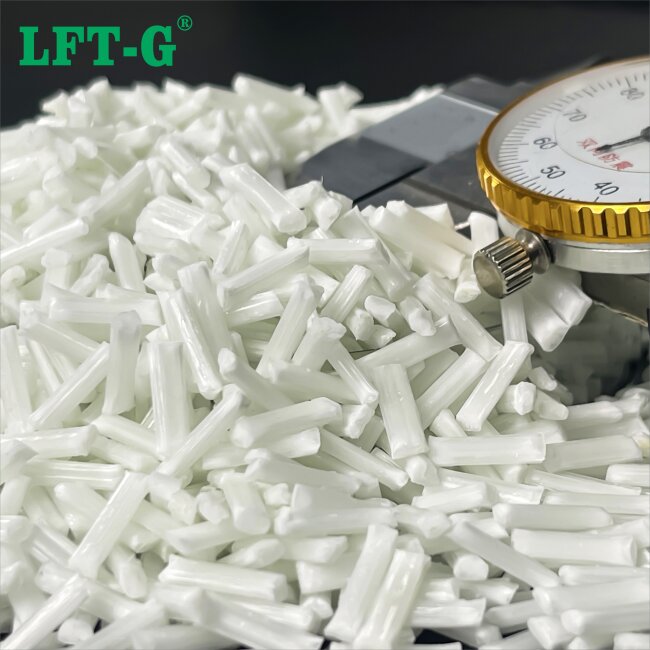
By incorporating longer glass fibers into a thermoplastic resin matrix, LFT materials combine the lightweight characteristics and processing flexibility of plastics with significantly enhanced mechanical properties.
Compared with conventional unreinforced plastics, long glass fiber reinforced materials offer several important advantages.
Long glass fibers improve the load-bearing capacity of the resin matrix, increasing tensile strength, flexural strength, and flexural modulus. These properties are particularly important for industrial fan blades exposed to rotational loads and continuous mechanical stress.
With appropriate material selection and structural design, long glass fiber reinforced materials can help reduce deformation under mechanical loads and temperature variations, supporting dimensional consistency and structural stability.
Compared with traditional metal materials, glass fiber reinforced thermoplastics generally have a lower density. With proper structural design, they can help reduce component weight while maintaining the required mechanical performance.
Unlike conventional metals, thermoplastic composites do not suffer from metal rusting. They offer advantages in humid and certain corrosive environments. Actual chemical resistance depends on the resin system and service conditions.
LFT materials are suitable for injection molding and can be used to manufacture industrial fan components with complex geometries, reinforcing ribs, and integrated structural features. This can also help reduce certain secondary processing operations.
Xiamen LFT Composite Plastics specializes in the development and production of long glass fiber and long carbon fiber reinforced thermoplastics, providing advanced composite material solutions for industrial component manufacturers.
For industrial fan blades and other rotating structural components, we offer different resin systems and glass fiber reinforcement levels according to specific application requirements, including:
Offers relatively low density and balanced mechanical properties, making it suitable for industrial components requiring a combination of lightweight design, stiffness, and cost efficiency.
Provides high mechanical strength and stiffness for engineering applications with demanding structural requirements.
Offers good mechanical performance and heat resistance, making it suitable for more demanding industrial structural components.
Our LFT-G long fiber reinforced pellets are manufactured using long fiber reinforcement technology. Glass fiber content can be customized according to the specific grade and application, with a standard range of 20%–60%.
Compared with conventional short glass fiber reinforced materials, long glass fiber reinforced materials can retain longer fiber lengths after proper processing, helping improve impact resistance, stiffness, and overall mechanical performance.
For industrial fan manufacturers, material selection affects not only individual component performance but also product design, manufacturing efficiency, and total operating costs.
LFT-G can help customers select suitable resin systems, glass fiber contents, and material grades based on target mechanical properties, processing methods, and operating environments.
No single material is suitable for every industrial fan application. The right choice depends on actual operating conditions, performance requirements, and overall project costs.
| Material | Main Advantages | Potential Limitations | Typical Selection Considerations |
|---|---|---|---|
| Metal | High strength, rigidity, and heat resistance | Higher weight, possible corrosion, and surface treatment requirements | High-temperature and demanding structural applications |
| Conventional Plastic | Lightweight, corrosion-resistant, and easy to mold | May have limited stiffness and strength under demanding conditions | General ventilation and relatively low-load applications |
| Long Glass Fiber Composites | Enhanced stiffness, strength, and dimensional stability with relatively low density | Requires appropriate material selection, mold design, and processing control | Lightweight structural components with higher mechanical requirements |
Before finalizing a material selection, manufacturers should evaluate rotational speed, blade dimensions, aerodynamic loads, operating temperature, fatigue life, and safety requirements. For high-speed rotating components, appropriate dynamic balancing, mechanical strength evaluations, and long-term operating tests are also essential.
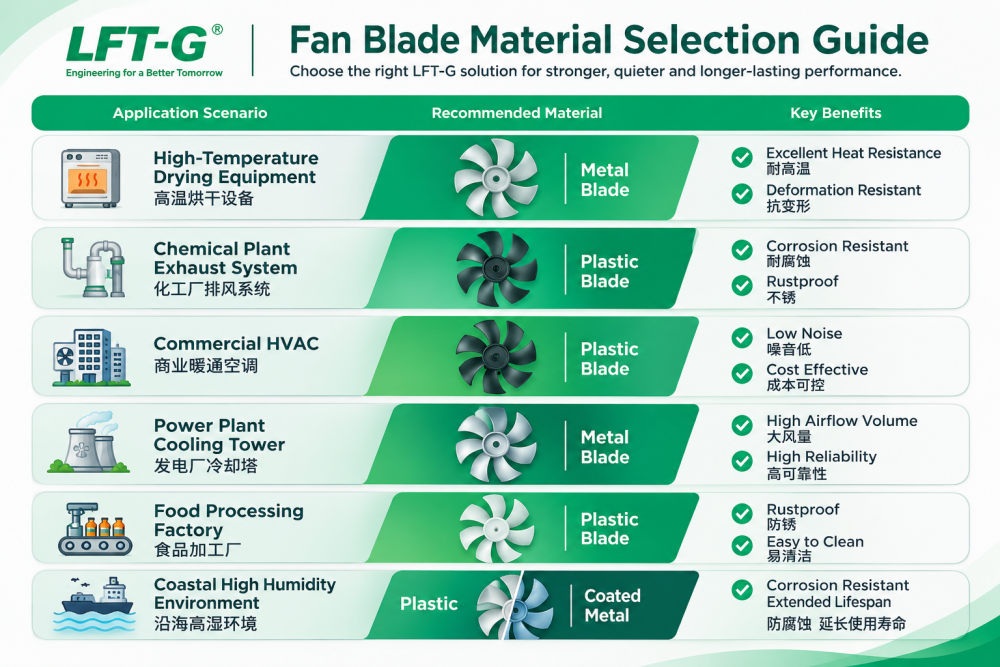
Metal fan blades offer high strength and heat resistance, while conventional plastic blades provide advantages in lightweight design, corrosion resistance, and processing flexibility.
However, as industrial cooling equipment continues to demand higher performance and efficiency, long glass fiber reinforced thermoplastics are becoming an increasingly attractive third option.
By combining long glass fiber reinforcement with thermoplastic resins, LFT-G provides material solutions that balance lightweight construction with enhanced mechanical performance for industrial fan blades.
Contact Xiamen LFT Composite Plastics to discuss your application requirements and explore suitable long glass fiber reinforced thermoplastic solutions.
Contact Our Technical TeamSiga-nos :


-- obtenha atualizações com os tópicos mais recentes

 o email
 português
 English
 français
 Deutsch
 русский
 italiano
 español
 العربية
 日本語
 한국의
 中文