novo blog
If you're developing lightweight structural components, you've probably faced a familiar challenge: reducing the weight of metal parts often compromises strength or drives up machining costs. Carbon fiber prepreg compression-molded parts offer excellent performance, but they come with high material costs, long production cycles, and low manufacturing efficiency. Conventional plastics are lightweight, but their stiffness and strength are often insufficient for load-bearing applications.
So, is there a material that can be directly injection molded, deliver strength exceeding 400 MPa, weigh less than aluminum alloys, and keep overall part costs under control?
Yes. Meet Long Carbon Fiber Reinforced Thermoplastic Injection Molding Composites (LCFT).
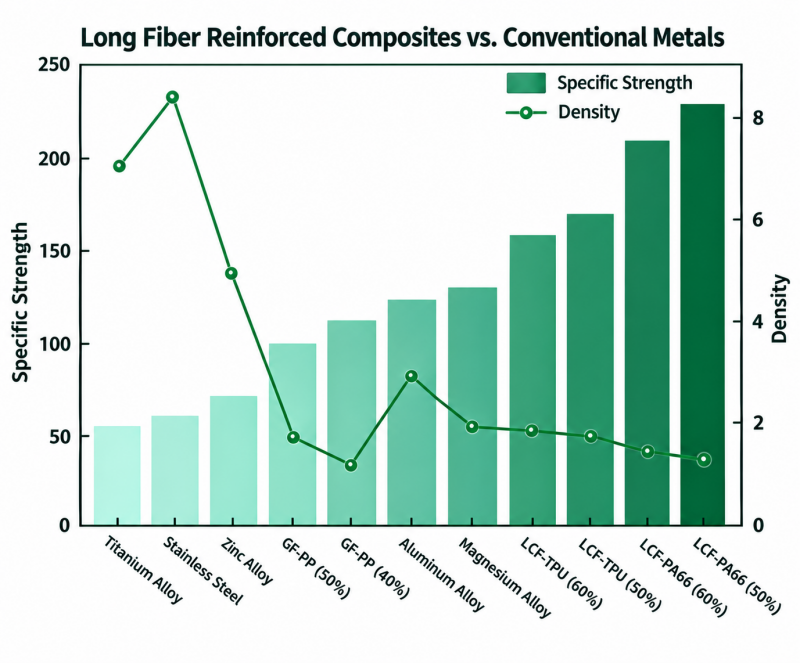
When it comes to lightweighting, many people focus on density. But lower density doesn't automatically mean better weight-saving performance. The key metric is specific strength—the ratio of tensile strength to density. It indicates how much load a material can withstand for its weight.
Take the widely used 6061 aluminum alloy as an example. It has a tensile strength of approximately 310 MPa and a density of 2.70 g/cm³, giving it a specific strength of around 115. By comparison, typical LCFT grades based on high-temperature polyphthalamide (PPA) offer tensile strengths of 350–420 MPa at densities of just 1.28–1.38 g/cm³, achieving specific strength values of approximately 260–310.
What does this mean in practical terms? For the same strength requirement, LCFT can reduce component weight to just 37–44% of the aluminum equivalent—a weight reduction of nearly 60%. This is not merely a theoretical advantage; it has already been achieved in mass-produced components.
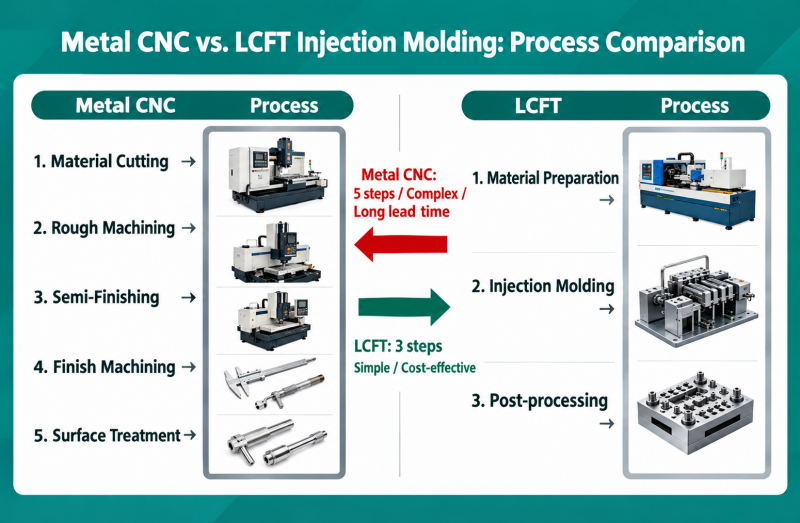
The first question many people ask is: “Isn’t carbon fiber expensive?” When comparing material prices alone, carbon fiber-reinforced pellets do cost more than conventional plastics and aluminum profiles. But the true cost of a structural component includes materials, processing, assembly, surface finishing, and scrap rates.
A typical metal component goes through multiple stages: starting with aluminum profiles or sheet metal, by CNC rough machining, finish machining, deburring, surface treatment, and final inspection. Each step adds equipment, tooling, labor, energy, and processing time to the total cost.
LCFT offers a much simpler process. The pellets are injection molded directly into a finished component, integrating ribs, clips, and mounting holes in a single molding cycle. Only minor trimming and inspection may be needed afterward.
What costs can be eliminated? CNC machining, welding, multi-part assembly, and much of the surface finishing.
For structural components of moderate complexity, LCFT injection molding can achieve total costs comparable to or even 10–30% lower than metal CNC machining. As production volumes increase, its cost advantage becomes even more pronounced.
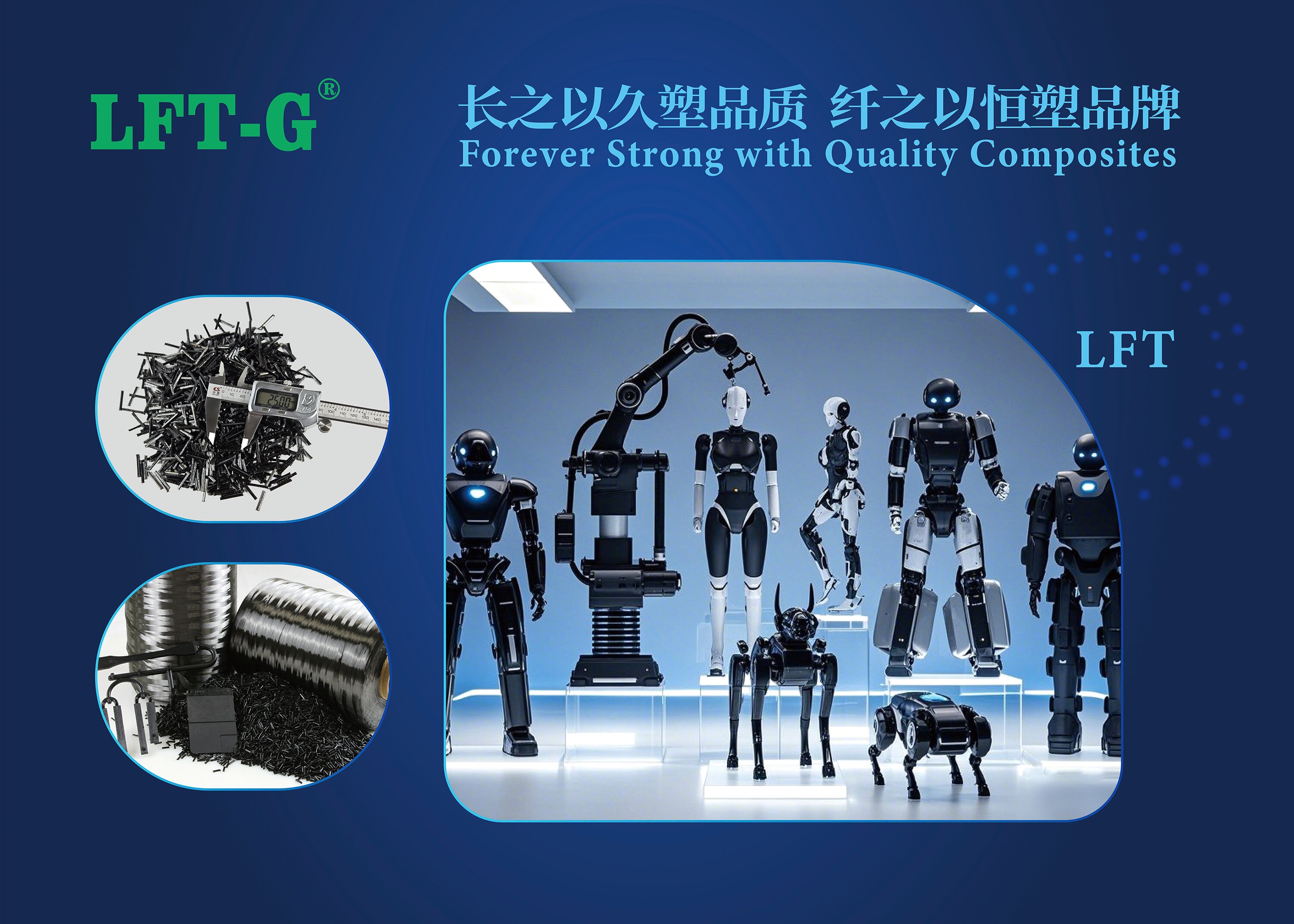
LCFT is already being used in volume production across multiple industries, delivering significant weight savings and performance benefits.
Across these applications, LCFT offers a compelling combination of high strength, reduced weight, design flexibility, and manufacturing efficiency.
Explore LFT-G's long carbon fiber reinforced thermoplastic composites for your next lightweight structural application. Contact our team for material recommendations, technical data, and customized quotations.
Contact LFT-G for Technical Support →Siga-nos :


-- obtenha atualizações com os tópicos mais recentes

 o email
 português
 English
 français
 Deutsch
 русский
 italiano
 español
 العربية
 日本語
日本語 한국의
한국의 中文
中文